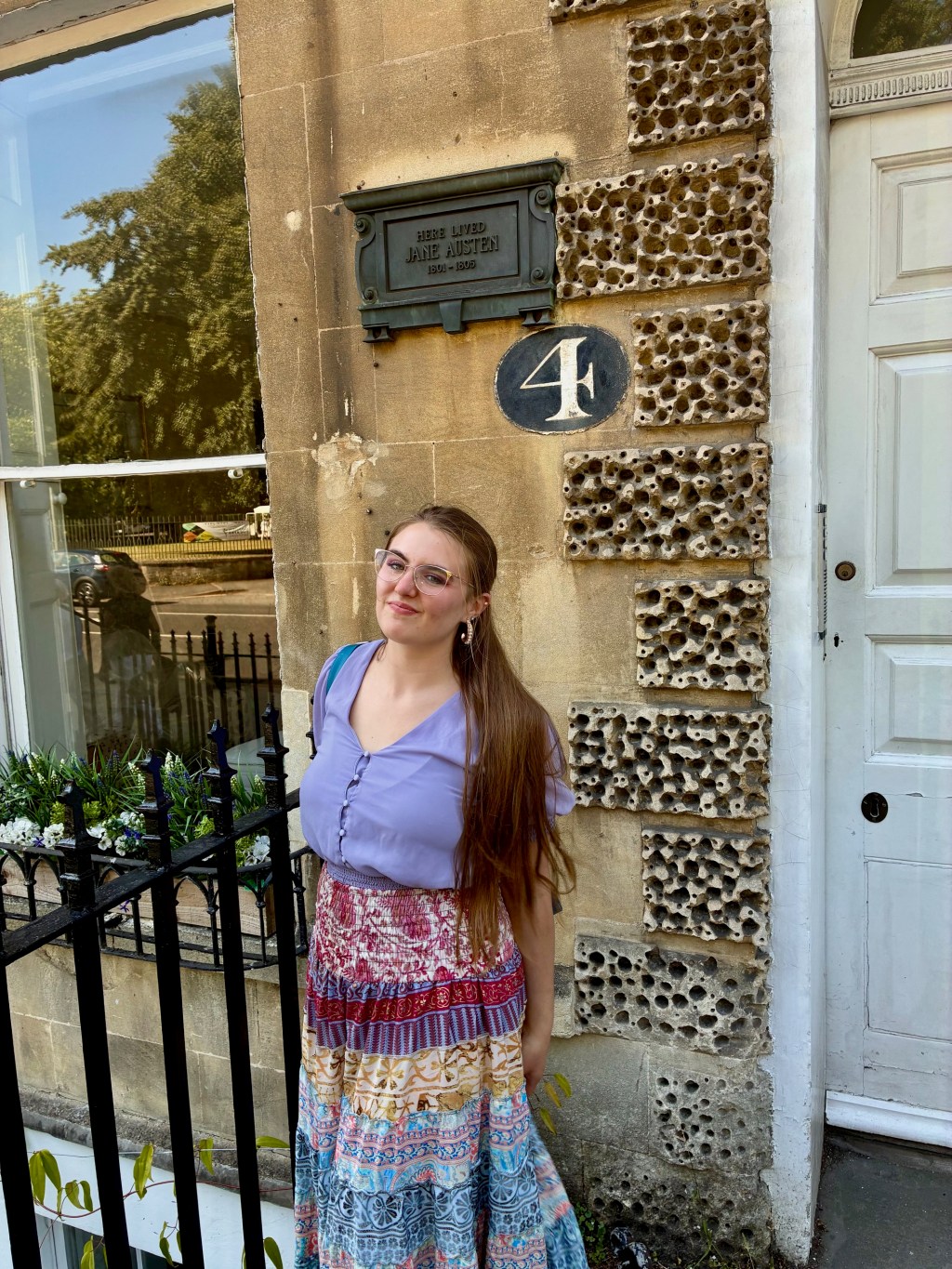
Three weeks into my studies in England, I can safely say that my knowledge of British culture, appreciation for Jane Austen literature, and love of tea has grown exponentially. Last Thursday, I completed my first Oxford tutorial examining the structure of courtship novels in Jane Austen’s works, particularly Northanger Abbey and Sense and Sensibility. After reading both novels, I constructed a 2,000-word essay before meeting with my Oxford tutor for the traditional tutorial, an hour-long discussion with my tutor to assess my knowledge of the subject, defend my argument, and geek out over Jane Austen books. Though the stress and imposter syndrome certainly kicked in, I was very proud of my paper, and I don’t think my tutorial could have gone any better.
To finish on a high note, a group of friends and I went to Bath this past weekend where Jane Austen lived for a number of years. We visited many locations featured in the books including the Pump House and the circulating library. After being totally emersed in Jane Austen’s world, I felt it only fitting to share my thoughts on the subject. Below is my finished essay examining Jane Austen’s use of courtship-novel structure and how it impacts her work. Take a look!
With reference to Northanger Abbey or Sense and Sensibility, how does Austen use the courtship novel for the purposes of social commentary? Explain:
When it comes to Jane Austen novices, unsuspecting readers might assume that the entirety of her plotlines can be boiled down to one word: romance. One look at ravenous Austen fans obsessing over Mr. Willoughby carrying a wounded Marianne to safety in Sense in Sensibility or swooning over Mr. Darcy’s notorious “hand flex” scene in the 2005 film adaptation of Pride and Prejudice seems enough to support the claim. Courtship romance certainly remains a recurring story arc in Austen’s works. However, Austen uses courtship-novel structure with specific and intentional purpose, not merely to delight her readers, but to serve as a backdrop for deeper discussion. The courtship novel offers Austen a medium for discussing her true opinions on society with elegance and tasteful humor. Thus, Austen masterfully transforms the generic courtship genre into a catalyst for satire, sarcasm, and societal examination.
Courtship novels, primarily popular in the mid-eighteenth to the early nineteenth century, had an all-too-predictable plotline which often focused on a woman’s entrance into society, the introduction of suitors, and a series of various mishaps eventually resulting in the heroine’s advantageous marriage (Magee 1). Since the courtship novel was a commonly enjoyed genre of the time, it naturally “was a convenient structure for unifying [Austen’s] character studies and themes” (Magee 1). Austen, however, was not merely adding to the noise of predictable plotlines—she was using the form as a means to shape her own narrative style. Romance was not the sole purpose of the story. Rather it was the springboard that catapulted characters to circumstances of higher existence and personal growth.
Besides its entertainment value and moral instruction, romance would have been a necessary addition to many stories of the day. In a publishing industry governed strongly by the day’s patriarchal, publishers might carry presumable distaste for novels that did not see heroines domestically settled by the final chapter, thus setting a poor example for their mostly-female readers. In order to reach readers, Austen had to ensure that her work got before an audience in the first place. In other words, her books had to sell. Thus, she delivered what readers and publishers both desired: a romance. The courtship novel was a perfect medium. By meeting desired criteria from potential publishing gatekeepers, Austen not only broke into the male-dominated publishing world, but she secured a platform for sharing her values through literary devices such as plot or dialogue. She adapted the stereotypical courtship novel to a storytelling voice entirely her own. Particularly in her later books, “instead of accepting [the courtship novel] as a fixed structure, she enlarged it and modified it to suit her specific purpose in each novel. By doing so she made the convention a vital feature of her own art and developed it into a criticism of the life allotted by her society to young women of the times” (Magee 11). Austen’s personal style accurately describes in a way that reflects the time period and yet challenges their place in society through critique, criticism, and commentary.
A prime example is Austen’s amusing parody of gothic literature, Northanger Abbey. Though Austen makes sure to include hair-raising suspense and thrilling romance, her courtship-novel structure laced with gothic tradition serves mostly as an exaggeration meant to poke fun at the popular gothic novels of the time. The Encyclopedia of Britannica defines parody, “in literature [as] an imitation of the style and manner of a particular writer or school of writers (. . .) typically negative in intent: it calls attention to a writer’s perceived weaknesses or a school’s overused conventions and seeks to ridicule them” (Britannica). Throughout Northanger Abbey, Austen frequently uses parody to show the ridiculousness of Catherine’s situation when added to her overactive imagination. The stereotypical gothic chest lurking in the guestroom corner must hold appalling secrets—lo and behold, it contains only receipts, shopping lists, and farrier bills (Northanger Abbey 160-161, 163-164). Such parallels are amusing for readers expecting thrills only to be exposed and surprised by normality. Britannica does concede that “Parody can, however, serve a constructive purpose” (Britannica). In the case of Northanger Abbey, Austen not only illustrates how gothic literature differs from real life, but offers an alternative heroine in Catherine who, once she escapes her overactive imaginings, is capable of clear-headed bravery.
Though technically a courtship novel, Northanger Abbey devotes more time to Catherine’s character, ridiculous societal norms, and the true qualities of a heroine than actual romance. A hasty marriage wraps up the story’s loose ends, but even the climax centers around Catherine’s own character development rather than a passionate proposal. When Catherine is disgracefully removed from the Tilney house, she must take her situation into her own hands and put to use all she has learned about herself and the world to see herself safely home (Northanger 214-218). Ironically, Catherine does not swoon at danger as a gothic heroine might. Though certainly a victim of unfortunate circumstances, Catherine does not fall into the gothic mindset of seeing herself as a prisoner of any situation or person. Instead, she focuses on solving the task at hand with as much courtesy, integrity, and dignity as possible. Through such events, the story delineates from an expected courtship plotline where the man might save the day to give readers a prime example of how a true heroine ought to act, especially when no one is coming to their rescue.
Northanger Abbey is not only a parody of the gothic but a commentary on the times. While allowing Catherine to indulge in the rituals of society, Austen seems to be simultaneously laughing at them. She repeatedly hints how ridiculous Mrs. Allen looks as she parades around the pump room, loudly hinting that she wishes they had someone to talk to (Northanger 22, 23). Mrs. Allen’s actions technically align with the social expectations of not speaking to strangers, but her conduct is slightly embarrassing. Though such social restrictions were common etiquette at the time, Austen’s blunt imagery illustrates society’s skewed view of manners. Austen extends her criticism of formal introductions when Catherine dances with Mr. Tilney who feels it necessary to circle back to painfully generic introduction questions if he is to be considered a virtuous gentleman. Even though they have already enjoyed discussing other subjects, he insists on hearing Catherine’s reception of Bath instead of letting natural conversation flow or asking intentional questions that would reveal her character (Northanger 25, 26). Readers purely interested in the romance might interpret the scene as simply playful banter, but on a deeper level, Austen seems to question the legalistic enforcement of rules on etiquette when such ridiculous double standards exist in other areas of decorum.
Northanger Abbey isn’t the only story to examine society under the guise of courtship romance. Though Sense and Sensibility is much closer to the traditional courtship novel with its suspense of competing suitors and the occasional—or in some cases, frequent—fits of hysterics, Austen includes much of her own social commentary as well. In Sense and Sensibility, Austen fashions a compelling satire contrasting two similar but competing virtues—logic and emotion—through the personification of two sisters, Elinor and Marianne. According to the Encyclopedia Britannica, satire is “an artistic form . . . in which human or individual vices, follies . . . or shortcomings are held up to censure by means of ridicule . . . sometimes with an intent to inspire social reform” (“Parody”). Austen artfully holds up two extremes to draw comparisons in female behavior and discuss where the perfect balance lies. Though some readers may simply view the novel as an entertaining love story, in reality Austen is characterizing two opposite sides of the emotional spectrum through satirical caricature.
Besides the obvious comparison between the relative virtues of sense and sensibility, Jane Austen’s debut novel is far from simply a courtship tale. Throughout her plot and character interactions, she clearly critiques the double sexual standard for men and women, the negative implications of excessive sensibility, and even the darker consequences of so-called sense in social interactions. To illustrate, Lucy says all of the right things, but in reality masks petty malice under the facade of false kindness. Lucy’s frequent competing scripts slip passive aggressive messages to Elinor even though her remarks seem polite at surface level. She tells Elinor that she values her confidence so much, “‘because you are an indifferent person,’ . . . laying a particular stress on those words . . . ‘If you could be supposed to be biased in any respect by your own feelings, your opinion would not be worth having’” (Sense, 112). Though at face-value, she seems to have complemented Elinor, in truth she gave her a back-handed slap by not only flaunting her own attachment with Edward but strongly insinuating that Elinor is indifferent to Edward—and if she isn’t, warning her that she should be. Though Lucy is arguably following the social conventions of conversation, anyone can see her true motives. Similar to Northanger Abbey, Austen critiques the social expectations placed so heavily on conversation when matters of character—particularly in men— are more easily excusable.
The largest commonality however between works such as Northanger Abbey and Sense and Sensibility is how Austen treats her heroines as the heroes of their own stories. Catherine and the Dashwood sisters are clearly the main characters and not merely helpless women requiring suitors. Though the courtship novel’s stereotypical “entering society” moment could easily happen in a woman’s home town, Austen interestingly removes her protagonists from their homes and casts them out into the world which gives them greater autonomy to explore and grow as characters. Austen writes in Northanger Abbey that “If adventures will not befall a young lady in her own village, she must seek them abroad” (Northanger 18). True to her own words, in both stories Austen sends her heroines off in a fashion that mirrors, not the courtship arc, but the hero’s journey plot arc which centers around personal growth, not securing a respectable marriage. If Austen’s stories were merely courtship novels, her heroines could just as easily await the perfect suitor from the comforts of their own home. Instead, Austen releases them into society where they must not only find a suitable match, but experience self discovery. Each heroine’s journey allows her to be proactive as she learns about the world and herself before returning home with new knowledge that will better direct her future when the inevitable proposal does arrive. Unlike similar courtship novels, the intentional hero’s journey elements reveals that as an author, Austen views her protagonists as women first and wives second.
Ultimately the courtship novel structure is clearly seen through Jane Austen’s work, but her views on society and her emphasis of a woman’s value allow her to bend the common plot-arc to her own creative devices. Though she features more traditional courtship in her earlier novels, according to “Instrument of Growth: The Courtship and Marriage Plot in Jane Austen’s Novels,” the more Austen uses the courtship novel the more she strays from its framework: “After Northanger Abbey and Sense and Sensibility, Jane Austen was no longer content to use the courtship and marriage convention as an arbitrary static device to unify her social satire. Freeing her plots from the rigidity of the prototype as it came to her, she developed variations that are thematically significant and structurally dynamic as they look to the founding of new and positive groupings” (Magee 206). In the end, Austen masterfully uses the generic frame of the courtship novel to insert her own social commentary into the world in a time when women had very little voice. By expressing herself through the common courtship novel, Austen not only empowered female voices, but delighted and enchanted readers for generations to come.
Works Cited:
Austen, Jane. Northanger Abbey. Penguin, 2003.
Austen, Jane. Sense and Sensibility. Wordsworth Classics, 2007.
Elliott, Robert C. “Satire.” Encyclopædia Britannica, Encyclopædia Britannica, inc., http://www.britannica.com/art/satire. Accessed 25 June 2025.
Magee, William H. “Instrument of Growth: The Courtship and Marriage Plot in Jane Austen’s Novels.” The Journal of Narrative Technique, vol. 17, no. 2, 1987, pp. 198–208.
JSTOR, http://www.jstor.org/stable/30225182. Accessed 25 June 2025.
“Parody.” Encyclopædia Britannica, Encyclopædia Britannica, inc., 30 May 2025, http://www.britannica.com/art/parody-literature.


Leave a Reply